

Age questions about pilot training come from two very different directions. Younger students want to know how early they can start. Older adults want to know whether they have waited too long. The FAA has specific answers to both, and the answer to the second question is less restrictive than most people assume.
Here are the exact FAA age requirements for every major certificate and rating, what you can do before you reach those ages, and why neither question has an answer that should stop anyone from starting.
FAA Minimum Age Requirements by Certificate
| Certificate or Rating | Minimum Age to Earn | Minimum Age to Solo |
|---|---|---|
| Sport Pilot License | 17 | 16 |
| Private Pilot License | 17 | 16 |
| Recreational Pilot Certificate | 17 | 16 |
| Instrument Rating | 17 (held with PPL) | N/A |
| Commercial Pilot Certificate | 18 | N/A |
| Flight Instructor Certificate (CFI) | 18 | N/A |
| Airline Transport Pilot (ATP) | 23 | N/A |
| Glider or Balloon Pilot | 16 (glider solo at 14) | 14 (glider) |
All ages above are minimums. There is no FAA maximum age to earn a private, sport, recreational, commercial, or CFI certificate. The ATP certificate requires pilots to retire from airline operations at age 65 under current FAA regulations.
For Young Students: Starting Before 17
You do not need to wait until 17 to begin flight training. The FAA allows student pilots to begin logging flight time with a certified flight instructor at any age. There is no minimum age to start taking lessons.
What you can do before 16:
- Take flight lessons with a CFI and log that time in your logbook
- Complete ground school and study aeronautical knowledge
- Take the FAA written knowledge test (no minimum age for the written test)
- Build toward your solo endorsement
What you can do at 16:
- Fly solo as a student pilot in airplanes and powered parachutes after receiving the required endorsements from your CFI
- Earn a Glider Pilot Certificate (minimum age 16 for powered gliders, 14 for non-powered gliders)
- Continue accumulating flight hours toward your Private Pilot certificate
What you can do at 17:
- Earn your Private Pilot Certificate or Sport Pilot License
- Earn a Recreational Pilot Certificate
- Hold an Instrument Rating (in combination with a PPL)
Students who start training before 16 and fly consistently can be ready for their solo endorsement on their 16th birthday and ready for their Private Pilot checkride on or shortly after their 17th birthday. For motivated young pilots, starting early is a genuine advantage.
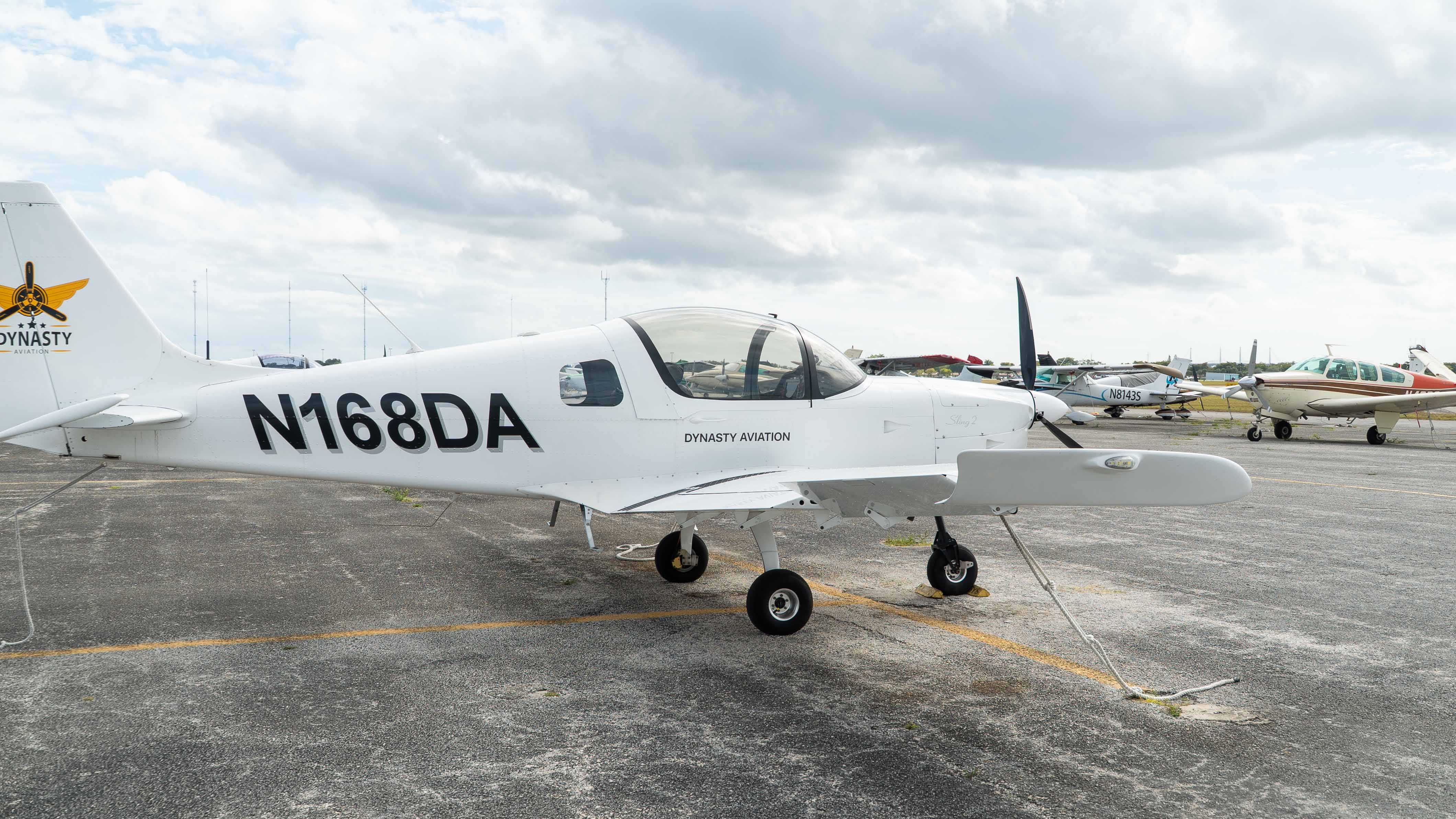
At Dynasty Aviation, student pilots train in the Sling LSA and Van's RV-12 iS, both of which qualify as Light-Sport Aircraft for Sport Pilot and student pilot operations. All training is conducted at North Perry Airport (KHWO) in Pembroke Pines under one-on-one instruction with a certified flight instructor. There is no minimum age to begin.
For Older Adults: Is There a Maximum Age?
No. The FAA does not set a maximum age for earning a Private Pilot, Sport Pilot, Recreational, Commercial, or CFI certificate. People in their 30s, 40s, 50s, and 60s earn pilot certificates every year. The certificates themselves do not expire.
The one age-related restriction in U.S. aviation is the mandatory retirement age for airline pilots serving as pilot-in-command on commercial airline operations, which is 65 under current FAA regulations. This applies specifically to airline captains operating under Part 121 air carrier rules. It does not apply to:
- Private pilot flying
- Sport pilot flying
- Commercial operations below the Part 121 threshold
- Flight instruction
- Charter flying under certain Part 135 categories
For anyone whose goal is recreational flying, traveling, or personal use of a pilot certificate, there is no age ceiling. A 60-year-old who earns a Private Pilot certificate can fly for the rest of their life provided they maintain their FAA medical certificate.
Medical Certificate Considerations for Older Pilots
The FAA medical certificate does not have a maximum age either, but renewal frequency increases with age for First Class medicals:
- Third Class Medical (required for Private Pilot): Valid for 5 years if you are under 40 at the time of issue, 2 years if you are 40 or older
- Second Class Medical (required for Commercial Pilot operations): Valid for 1 year regardless of age
- First Class Medical (required for ATP/airline operations): Valid for 12 months if under 40, 6 months if 40 or older
Age-related medical conditions become more relevant at higher ages, particularly for First Class medicals. Prospective pilots with existing health conditions should consult an FAA Aviation Medical Examiner before investing significantly in training. Most common age-related conditions, including controlled hypertension and corrected vision changes, are manageable under FAA medical standards. An early AME consultation removes uncertainty before it becomes expensive.
The Sport Pilot pathway removes the medical question entirely for older pilots. A valid U.S. driver's license serves as your medical qualification for Sport Pilot operations, no FAA medical exam required, provided the driver's license has never been denied or revoked on medical grounds. For pilots over 60 whose primary goal is personal recreational flying, the Sport Pilot route is worth considering specifically because it sidesteps the medical renewal cycle entirely. See the Sport Pilot and driver's license guide for details.
Does Age Affect How Fast You Learn to Fly?
Not meaningfully in the early stages, and not at all in terms of what certificates you can eventually earn. The skills required for Private Pilot training, aircraft control, radio communication, navigation, and aeronautical decision-making, are skills that adults develop as readily as younger students. Many instructors report that adult learners with professional backgrounds bring discipline, attention to detail, and ground study habits that young students without those habits have to develop during training.
The one area where age creates a practical difference is in career planning. Airline seniority is the defining variable in a commercial pilot career. Seniority is earned chronologically from your date of hire, and a pilot hired at 30 will permanently outrank a pilot hired at 40 at the same airline, regardless of ability. For pilots pursuing airline careers who are starting later in life, earlier is always better.
For recreational pilots, this consideration is irrelevant. The 55-year-old who earns a Private Pilot certificate this year can fly for the next 30 or more years with no seniority system involved.
The Career-Track Age Question
For adults considering a career change into commercial aviation, the math on age is real and worth understanding honestly before investing in training.
The mandatory retirement age for airline pilots is 65. Regional airline captains typically earn $120,000 to $180,000 or more annually. Major airline pilots earn substantially more. A pilot who begins training at 35, completes their certificates and CFI by 37 or 38, builds to 1,500 hours by 39 or 40, and is hired at a regional airline at 40 has 25 years of airline flying ahead of them. That career window is substantial and financially significant.
A pilot who begins training at 50 has a shorter window, but still a meaningful one. Regional airline first officer positions are available at 1,500 hours. The career path still makes financial sense evaluated over a 15-year horizon at current pilot salaries, which have increased dramatically in the last five years.
What does not make sense is delaying the start of training while the career question is unresolved. Every year of delay is a year of seniority and earnings that cannot be recovered. If the goal is a commercial career, the right time to start is now, regardless of current age.
For a full breakdown of the airline career path and timeline, see the how to become an airline pilot guide.
Student Pilots Under 18: What Parents Need to Know
Flight training for minors is fully legal and common. The FAA does not require parental consent to begin taking lessons. However, most flight schools require written parental consent for students under 18 before they will enroll a minor in a training program, issue a solo endorsement, or schedule a checkride.
At Dynasty Aviation, minor students receive the same one-on-one instruction model as adult students. Young pilots training in the Sling LSA or RV-12 iS at North Perry Airport are working in real South Florida airspace with a certified instructor from the first lesson. The training environment builds exactly the discipline and situational awareness that young pilots need to develop before flying solo.
A discovery flight is the right first step for any young student and their parents before committing to a program. It takes about two hours, it flies over Fort Lauderdale and Miami airspace, and it gives both the student and their parents a concrete picture of what training involves before any enrollment decision.
Age Requirements Summary
- No minimum age to begin taking lessons or logging flight time
- 14 to solo in a non-powered glider
- 16 to solo in an airplane, powered parachute, or weight-shift control aircraft
- 16 to earn a Glider Pilot Certificate
- 17 to earn a Private Pilot, Sport Pilot, or Recreational Pilot Certificate
- 18 to earn a Commercial Pilot Certificate or CFI certificate
- 23 to earn an Airline Transport Pilot certificate
- No maximum age for any certificate except ATP airline operations (mandatory retirement at 65)
Frequently Asked Questions
Can a 15-year-old take flight lessons? Yes. There is no minimum age to begin flight training with a CFI. A 15-year-old can take lessons, log flight time, and study ground school. They cannot fly solo until age 16 and cannot earn a Private Pilot certificate until 17, but starting early means being solo-ready on their 16th birthday and checkride-ready shortly after their 17th.
Can a 70-year-old get a pilot's license? Yes. There is no maximum age for a Private Pilot, Sport Pilot, or Recreational Pilot certificate. A 70-year-old who passes the FAA medical exam and demonstrates the required proficiency at their checkride receives the same certificate as a 17-year-old who does the same. The Sport Pilot pathway with a driver's license as medical qualification is also available provided the license has not been denied or revoked on medical grounds.
Do you need a parent's permission to take flight lessons as a minor? The FAA does not require parental consent for lessons. Most flight schools, including Dynasty Aviation, require written parental or guardian consent before enrolling students under 18 and before issuing solo endorsements. Bring a parent or guardian to the discovery flight.
Does age affect what aircraft you can fly? No. The same certificates authorize the same aircraft regardless of the pilot's age. A 17-year-old Private Pilot and a 65-year-old Private Pilot hold identical privileges with respect to aircraft categories and classes.
Is there an age limit for the FAA written knowledge test? No. The FAA written knowledge test for any certificate can be taken at any age. Many young students take the written test before they are old enough to solo, using the study period productively while they wait to reach the minimum age.
Book a Discovery Flight | View the Private Pilot Program | View the Sport Pilot Program | Contact Us
Dynasty Aviation is an FAA Part 141 approved flight school based at North Perry Airport (KHWO) in Pembroke Pines, Florida, serving student pilots throughout Fort Lauderdale, Miami, Broward County, and South Florida.
Compartir:
How to Pay for Flight School: Financing, Loans, and Scholarships Explained (2026)
How Much Do Airline Pilots Make in 2026? (Complete Breakdown)