

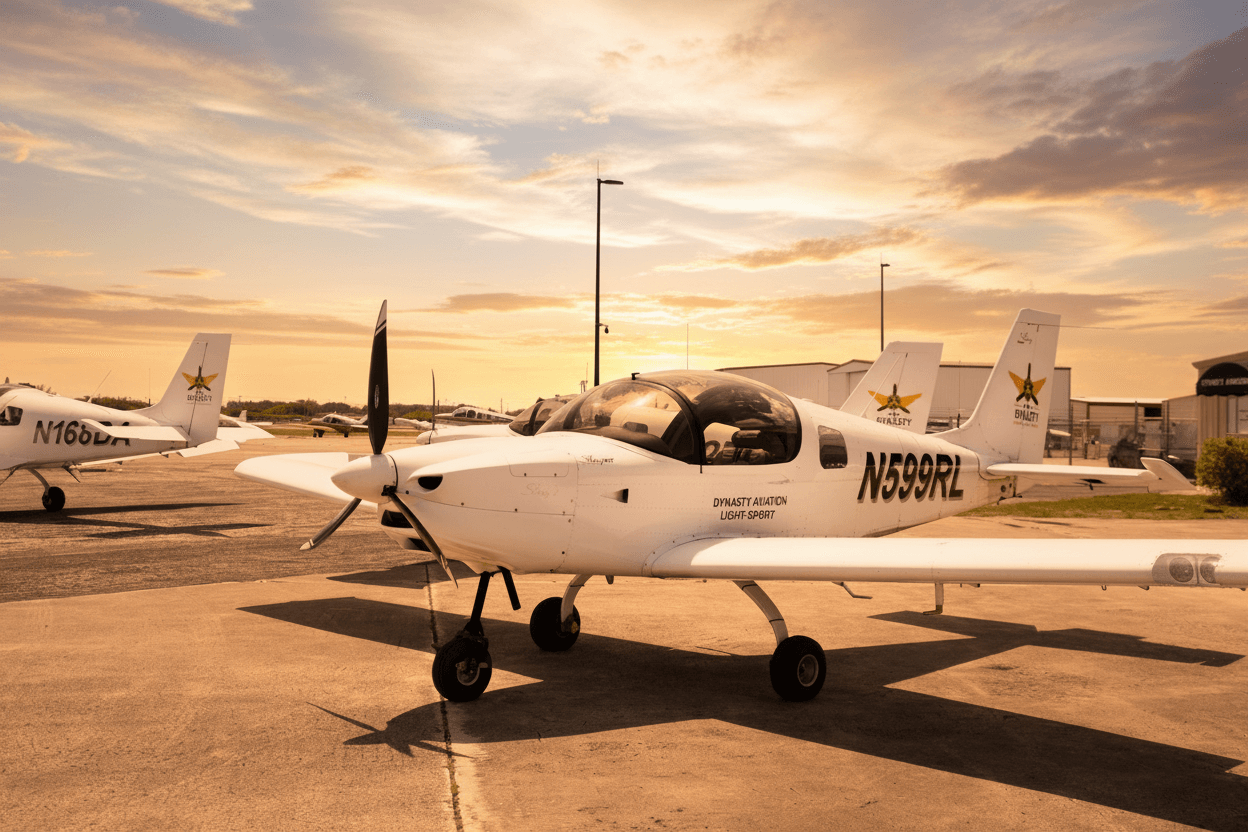
Flight Training FAQ: How to Train Smarter, Save Money, and Earn Your Wings
Everything you need to know about flight training at Dynasty Aviation—straight from the school owner. Covering costs, lesson prep, checkrides, radio communication, and everything in between.
Why is 1-on-1 ground instruction required before every flight lesson?
The airplane is one of the worst places to learn something for the first time—especially when the Hobbs meter is running and every minute costs money. If you don't fully understand a concept on the ground, it becomes much harder to absorb in the air while simultaneously flying the airplane.
Study and learn on the ground. Practice and apply in the air. The airplane is for applying what you already know—not for learning concepts from scratch.
One-on-one ground instruction also covers Dynasty-specific procedures, aircraft systems, and North Perry Airport operations that no online course can replicate.
What is chair flying, and why is it one of the most powerful training tools available?
Chair flying is mentally rehearsing flight procedures out loud, step by step, from memory—while sitting in a chair on the ground. It costs nothing. Even 30 minutes per day makes a measurable difference. Here's how to do it correctly:
- 1Open your Private Pilot Standardization manual to the maneuver you want to master.
- 2Recite all steps out loud from memory—every RPM, every airspeed, every checklist item.
- 3If you get anything wrong, restart from step one immediately. No shortcuts.
- 4Once you can recite the full sequence perfectly, use a timer to build speed.
When you already know the procedure cold, your brain has more attention available to actually fly the airplane. Maneuvers that once felt overwhelming start to feel natural—because they are.
Why do I need to arrive 15 minutes early before each lesson?
Those 15 minutes aren't buffer time—they're part of the lesson. Arriving early gives you time to:
- ✓Complete the briefing sheet
- ✓Check current weather and NOTAMs
- ✓Perform the preflight inspection thoroughly
- ✓Review lesson objectives and ask any last questions before the flight
Students who arrive "on time" are often still asking setup questions while the engine starts. That costs money and focus.
How can I keep my total flight training costs as low as possible?
Preparation is the single most powerful cost-reduction tool in flight training. Before every lesson: know the goal of the flight, review your notes, study the material, and understand the procedures you'll be practicing.
A useful test: if you can explain a concept clearly to someone who has never flown, you probably understand it well enough to practice it in the airplane. Stumble on the explanation? You're not ready to fly it yet.
You should never fly a lesson that hasn't been properly taught or explained first—except during demonstrations.
How do I avoid repeating lessons?
Lessons repeat because students leave class with unresolved questions, then try to figure things out on their own—and show up to the next session without the foundation they need. The cycle is expensive.
- 1Never leave class confused. Ask questions before you walk out the door.
- 2Review and study consistently between lessons—not just the night before.
- 3Chair fly every day. The more familiar you are on the ground, the less repetition you need in the air.
Why is passing the Knowledge Exam early so important?
The FAA written exam is technically only required before your End of Course checkride—but waiting until the end is a common and costly mistake. Many students finish all their flight training, feel ready for the checkride, and then get delayed because the written exam isn't done.
Complete it early. Use tools like CTA or Sporty's to prepare. But don't just memorize answers—understand the material. Examiners probe for genuine knowledge on checkrides. If you have gaps, schedule a ground lesson and work through them.
Why do my lessons keep repeating even when I feel like I'm trying?
Start with what you can control. Ask yourself honestly:
- ?Did I chair fly before this lesson?
- ?Do I fully understand the lesson—not just the steps, but the why?
- ?Can I explain the maneuver out loud confidently, without looking at my notes?
- ?Am I improving and getting smoother each time?
If you're answering yes to all of these and still repeating, talk to your instructor. Ask directly: "What's missing? Where are my blind spots?"
Why do I blank out on my instructor's questions even though I studied?
This happens to almost every student pilot. What makes sense in your head often doesn't come out clearly when you try to say it—especially under pressure.
The fix: say things out loud during your studying, not just in your head. Recite concepts, explain them to someone, teach the material to a family member.
Most aviation knowledge should be understood, not memorized mechanically. When you truly understand why something works, it's much harder to forget under pressure.
Why do I struggle so much with radio communications?
Radio communication is genuinely difficult—even for native English speakers. The phraseology is formal, abbreviated, and fast. There's no shortcut other than deliberate practice.
- ✓Listen to LiveATC.net for your home airport and practice following along
- ✓Watch aviation YouTube channels that feature real ATC communication
- ✓Practice radio calls with classmates and role-play ATC scenarios
- ✓Review the ATC scenario guides your instructor provides—thoroughly
Why do I feel stuck preparing for my first solo, even after 20+ hours?
The traffic pattern is one of the biggest challenges in all of flight training. Radio calls, pattern entry, airspeeds, flap management, turns, spacing, and landing all happen at once.
Chair flying is critical here. Close your eyes and mentally walk through:
- 1Takeoff roll and rotation
- 2Pattern legs (crosswind, downwind, base, final)
- 3Radio calls at each position
- 4Airspeeds and flap settings at each stage
- 5The flare: as the airplane slows, gradually raise the nose until touchdown—like a power-off stall in slow motion
Memorize your Private Pilot Standardization by heart—traffic pattern procedures, airport operations, and all phases of landing. The more effort on the ground, the fewer hours needed in the air.
Why do I feel stuck during cross-country training?
Cross-country training isn't really about flying the airplane. By this point, you already know how to fly. The challenge is decision-making: managing radio calls across multiple airports, navigating airspace, planning fuel, and handling unexpected situations—all at the same time.
- ✓Chair fly the entire route before you fly it
- ✓Build a cheat sheet with radio frequencies, headings, waypoints, and timing
- ✓Practice radio calls for non-towered airports out loud before the flight
- ✓Discuss scenarios with your CFI: diversions, weather, lost communication
Why doesn't the Cessna Training Online course seem to help much with actual flying?
Cessna Training Online is a required component of Part 141 training and provides solid general aviation knowledge—weather, aerodynamics, regulations, and written exam prep. Think of it like the permit test for a driver's license: required, useful, but not the same as learning to drive.
The limitation is that CTO is built around aircraft and procedures that differ significantly from the Sling LSA and RV-12iS we fly at Dynasty, and from North Perry Airport's specific operations. That's exactly why one-on-one ground instruction is essential.
Why do I need to read the ACS with my CFI?
The ACS (Airman Certification Standards) lists every maneuver you'll need to demonstrate on your checkride, along with the exact standards the examiner will use to grade you. It's the closest thing to a checkride answer key.
- ✓Know exactly what the examiner expects from each maneuver
- ✓Understand the specific tolerances required (altitude, airspeed, heading)
- ✓See how the oral exam portion will be structured
Students who know the ACS inside and out go into checkrides with a clear roadmap—and significantly less anxiety.
Why is knowing where to find the answer more important than memorizing it?
On an FAA checkride, examiners don't just want your answer—they want to know where it comes from. Saying "my instructor told me" is one of the worst answers you can give. It signals reliance on secondhand information rather than primary sources.
ACS · FAR/AIM · FAA advisory circulars · Pilot's Operating Handbook (POH) · Your Chief Instructor. Bookmark them. Use them regularly. Get comfortable pulling answers from the source.
Why did I fail my stage check, and why is the pressure so intense?
Stage checks are designed to simulate the pressure of a real checkride. The evaluator is not there to teach—they're there to assess. That's intentional. Your ability to perform under pressure is part of the certification.
If an evaluator needs to intervene frequently, it usually means there are training gaps that need to be addressed, or you're not yet flying with the independence a checkride requires.
Examiners come in all personalities—friendly, serious, quiet, intense. None of that matters if you're flying the correct procedures confidently. Your Private Pilot Standardization Manual includes a Self-Evaluation Checklist for every stage check. Use it fully.
Can I fly with a different instructor if my regular CFI is unavailable?
Absolutely—and you should. Your training shouldn't stop because one instructor is unavailable. Flying with another CFI can actually benefit your development: a different perspective, additional feedback, exposure to different teaching styles.
The standards and procedures remain the same across all instructors. The style may vary—the expectations don't.
Can I change instructors if it's not working out?
Absolutely. As a student, you have the right to choose the instructor who fits your learning style best. Finding the right match is part of the process, and changing instructors has helped many students accelerate their training significantly.
Contact Dao directly to make a change. Explain the challenges you're facing, and we'll assign an instructor who's a better fit.
How do I secure my preferred training schedule?
Communicate early. Let your CFI know your preferred days and times as soon as possible—the further ahead you schedule, the better your chance of securing your preferred slots.
If your primary instructor isn't available, request another rather than skipping the lesson entirely. Gaps in training momentum are one of the most common causes of lesson repetition and added cost.
What's the most effective way to finish flight training in fewer than 65 hours?
The students who finish fastest share the same habits. There are no shortcuts—but there are clear patterns:
- 1Fully understand the knowledge. If you can explain a concept to a six-year-old, you understand it. Don't move on until you can.
- 2Study consistently. Not the night before. Every day, a little at a time. Preparation is the training.
- 3Do mock orals and practice flights. Everyone has blind spots. Different instructors will find what you can't see yourself.
- 4Trust your training. If your instructors have recommended you for a checkride, they believe you're ready. As long as the examiner hasn't stopped the checkride, you're still doing fine.
Listen carefully. Communicate clearly. If you don't understand a question, ask for clarification—it's allowed and it's smart. Communication is one of the most important skills in aviation.
Questions? We're here.
If your training feels stuck and you're not getting clear direction, reach out directly. Our mission is to help you reach your goals as efficiently and safely as possible.
分享:
How Many Hours Does it Take to Get a PPL?
What Happens at an FAA Checkride? Complete 2026 Guide