

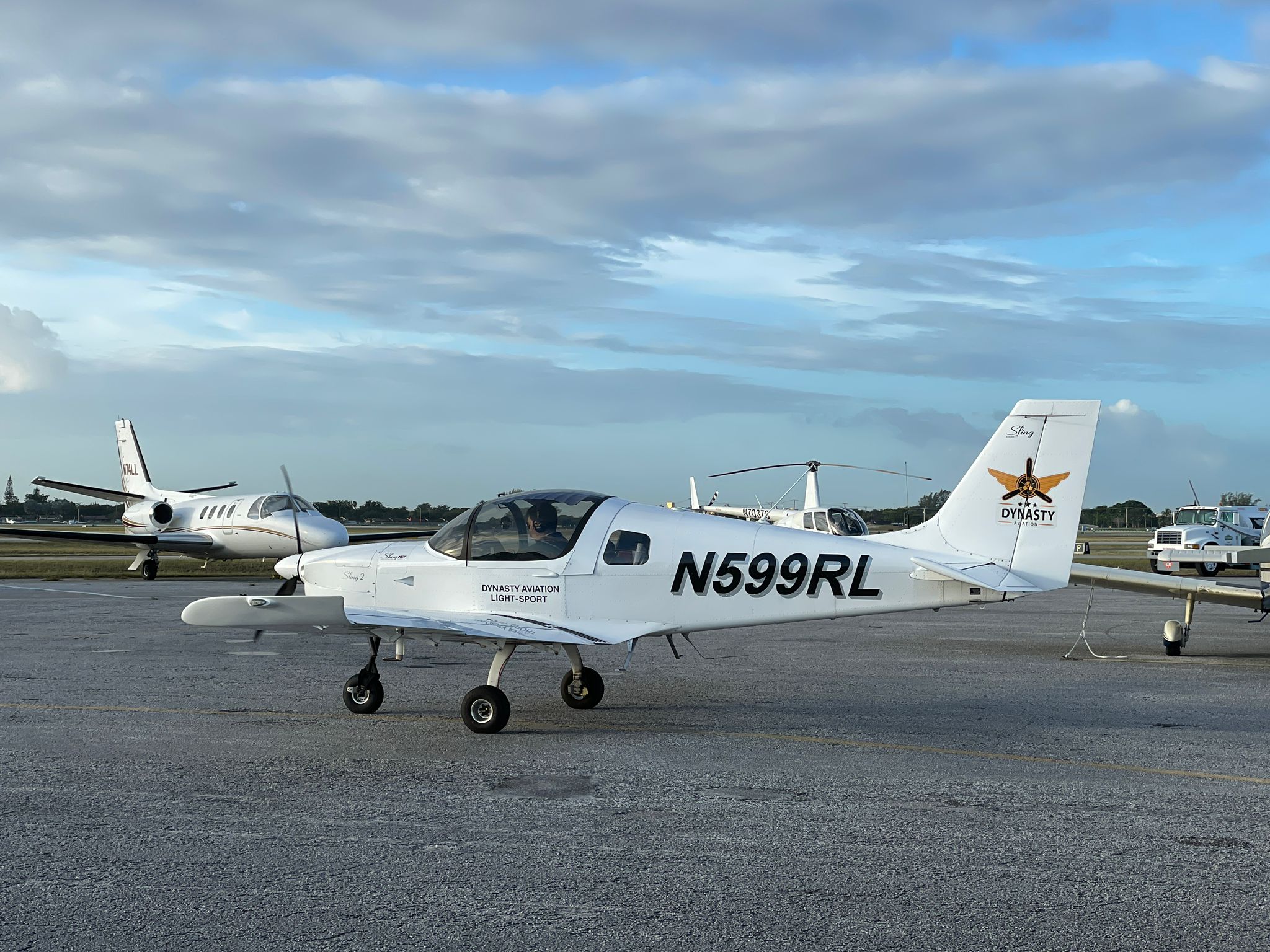
When you start researching flight schools in Fort Lauderdale and Miami, the aircraft question comes up early. Schools advertise their fleets heavily, and for good reason: the aircraft you train in directly affects what you learn, how much your training costs, how fast you progress, and how prepared you are for everything that comes after your initial certificate.
Most South Florida flight schools operate Cessna 172s, Piper Warriors, or similar legacy trainers ranging from 30 to 50 years old. Dynasty Aviation made a different choice. Every aircraft in the Dynasty fleet is modern, purpose-built for training, and equipped with Garmin glass cockpit avionics from the first lesson.
This is a complete breakdown of what those aircraft are, what they are used for in the program, and why the fleet composition matters more than most new students expect when they are first shopping for a school.
The Dynasty Aviation Fleet at a Glance
| Aircraft | Type | Primary Use | Avionics | Seats |
|---|---|---|---|---|
| Sling LSA | Light-Sport Aircraft | Sport Pilot, Private Pilot primary | Garmin G3X | 2 |
| Van's RV-12 iS | Light-Sport Aircraft | Sport Pilot, Private Pilot primary | Garmin G3X | 2 |
| Tecnam P2006T | Twin-Engine SEP | Multi-Engine Rating, Instrument, Commercial | Garmin G3X / G1000 NXi | 4 |
All three aircraft are maintained in-house by Dynasty Aviation's maintenance team at North Perry Airport (KHWO). In-house maintenance is not a minor point: it directly affects how often aircraft are available when scheduled, which directly affects training momentum and total training cost.
Aircraft 1: Sling LSA
The Sling LSA is Dynasty Aviation's primary trainer for Sport Pilot and early Private Pilot training. It is a two-seat, low-wing, all-metal Light-Sport Aircraft designed and manufactured by Sling Aircraft in South Africa, where the design has accumulated hundreds of thousands of flight school hours globally with individual aircraft exceeding 9,000 training hours.
Why the Sling LSA
Built specifically for flight school use. The Sling LSA was engineered from the ground up for high-cycle training operations, not adapted from a recreational design. All-aluminum airframe construction handles the structural demands of repeated student takeoffs, landings, and crosswind correction attempts over thousands of flight hours. Schools that train in composite aircraft face higher repair costs when student handling produces the inevitable surface contact or hard landing.
Rotax 912 iS engine. The Sling LSA is powered by a Rotax 912 iS, a fuel-injected, four-cylinder engine producing 100 horsepower. Fuel injection eliminates the carburetor ice concerns that affect older carbureted engines common in legacy trainers. The engine is well-proven in training environments with a strong reliability record and a fuel burn of 3 to 4 gallons per hour, significantly lower than the 6 to 8 gallons per hour of a typical Cessna 172 with a Lycoming O-320.
Garmin G3X glass cockpit. The Sling LSA is equipped with the Garmin G3X, which integrates attitude, airspeed, altitude, heading, navigation, traffic, terrain, and engine data into a unified primary flight display. Students learn instrument scan habits on the same avionics architecture used in modern professional aircraft from the first hour of training. For a full breakdown of why this matters for career pilots, see the glass cockpit vs steam gauge training guide.
Near 360-degree bubble canopy. The large wraparound canopy provides exceptional all-around visibility, which matters directly in North Perry Airport's busy traffic pattern. Seeing everything around you is not optional when multiple training aircraft, banner tow planes, and transient traffic are operating simultaneously.
Low operating cost. The combination of efficient fuel burn, modern engine reliability, and in-house maintenance produces lower operating costs per flight hour than legacy trainers, which Dynasty Aviation passes through to program pricing.
Sling LSA Key Specs
| Specification | Detail |
|---|---|
| Configuration | Two-seat low-wing monoplane |
| Construction | All-aluminum airframe |
| Engine | Rotax 912 iS, fuel-injected, 100 hp |
| Fuel burn | 3 to 4 gallons per hour |
| Cruise speed | Approximately 113 knots |
| Range | 850+ nautical miles |
| Maximum gross weight | 1,320 lbs (LSA certification) |
| Avionics | Garmin G3X glass cockpit |
| Canopy | Large bubble canopy, near 360-degree visibility |
What the Sling LSA Is Used For at Dynasty Aviation
The Sling LSA is the aircraft most Sport Pilot students will fly for their entire certificate and most Private Pilot students will use through the pre-solo and early solo phases of training. It qualifies fully for Sport Pilot operations and for Private Pilot certificate training under FAA regulations. Hours logged in the Sling count fully toward Private Pilot, Instrument Rating, and Commercial certificate requirements.
Aircraft 2: Van's RV-12 iS
The Van's RV-12 iS is the second Light-Sport Aircraft in Dynasty Aviation's primary training fleet, operating alongside the Sling LSA for Sport Pilot and Private Pilot training. Van's Aircraft is one of the most respected names in sport aviation, with more kits flying worldwide than any other kit aircraft manufacturer in history.
Why the RV-12 iS
Different handling characteristics, same avionics environment. The RV-12 iS offers slightly different handling and cockpit ergonomics than the Sling LSA while sharing the Garmin G3X avionics platform. Exposure to two aircraft types during primary training builds adaptability and reinforces the principle that aircraft handling varies while avionics proficiency transfers. Students who fly both aircraft during training develop the flexibility that distinguishes experienced pilots from those who have only ever operated one type.
Proven airframe. The RV-12 design has accumulated a substantial safety and reliability record in flight school operations. The iS designation refers to the fuel-injected Rotax 912 iS engine, the same powerplant used in the Sling LSA, which means common maintenance tooling, parts familiarity, and engine knowledge across the fleet.
Garmin G3X. Like the Sling LSA, the RV-12 iS runs the Garmin G3X. Students moving between aircraft encounter the same primary flight display, the same moving map, and the same engine monitoring interface. There is no avionics transition to manage between types.
Sport Pilot eligible. The RV-12 iS qualifies fully as a Light-Sport Aircraft under FAA regulations, making it appropriate for Sport Pilot training with no FAA medical certificate required. A valid driver's license is sufficient to train and fly solo as a Sport Pilot in the RV-12 iS.
RV-12 iS Key Specs
| Specification | Detail |
|---|---|
| Configuration | Two-seat low-wing monoplane |
| Engine | Rotax 912 iS, fuel-injected, 100 hp |
| Fuel burn | 4 to 5 gallons per hour |
| Cruise speed | Approximately 115 knots |
| Avionics | Garmin G3X glass cockpit |
| Certification | Experimental Light-Sport Aircraft |
What the RV-12 iS Is Used For at Dynasty Aviation
The RV-12 iS fills the same primary training role as the Sling LSA. Scheduling between the two aircraft depends on availability and instructor assignment. Students who fly both during primary training finish with broader type exposure and stronger adaptability, which is an advantage in every subsequent stage of their flying career.
Aircraft 3: Tecnam P2006T
The Tecnam P2006T is Dynasty Aviation's multi-engine trainer and the aircraft used for advanced instrument and commercial training. It is a four-seat, high-wing, twin-engine aircraft manufactured by Tecnam, an Italian manufacturer with one of the strongest reputations in the light aircraft and training market.
The P2006T is widely regarded as the most economical piston twin available for training operations. Its twin Rotax 912 engines, modern avionics, and predictable handling characteristics have made it the aircraft of choice for flight training organizations globally.
Why the Tecnam P2006T
Twin-engine training at single-engine operating costs. The P2006T's two 100-horsepower Rotax 912 engines burn approximately 3.7 gallons per hour per engine, producing total fuel costs comparable to many high-performance single-engine trainers. For students pursuing multi-engine ratings and building twin-engine time toward airline careers, this makes the P2006T the most cost-accessible path to multi-engine proficiency available.
Constant-speed propellers and retractable gear. The P2006T is classified as a complex aircraft under FAA regulations, meaning it is equipped with both a controllable-pitch propeller and retractable landing gear. Training in a complex aircraft is required before earning a Commercial Pilot certificate, and the P2006T delivers both the complex aircraft endorsement and multi-engine experience in a single platform.
Modern avionics. Dynasty Aviation's P2006T is equipped with Garmin glass cockpit avionics consistent with the primary training fleet. Students advancing from the Sling LSA or RV-12 iS encounter a familiar avionics environment when transitioning to the twin, which means the focus of multi-engine training is on systems, engine management, and asymmetric thrust rather than learning a new avionics suite from scratch.
IFR certified. The P2006T is IFR certified and equipped for instrument approaches, making it the right platform for advanced instrument training in South Florida's Class B and Class C airspace corridor. For career-track students who want to build actual instrument time in a twin, the P2006T delivers that capability at a fraction of the cost of flying a conventional piston twin.
Predictable asymmetric handling. Multi-engine training's most critical skill is engine-out procedures and asymmetric thrust management. The P2006T's balanced twin-Rotax configuration produces predictable, manageable behavior during simulated engine failures that builds the procedural fluency airline training departments look for in multi-engine candidates.
Tecnam P2006T Key Specs
| Specification | Detail |
|---|---|
| Configuration | Four-seat, high-wing twin |
| Engines | 2x Rotax 912, 100 hp each |
| Fuel burn | Approximately 3.7 gph per engine |
| Cruise speed | Approximately 148 knots |
| Range | Up to 850 nautical miles |
| Gear | Retractable (complex aircraft) |
| Propellers | Constant-speed |
| Avionics | Garmin glass cockpit |
| IFR certified | Yes |
| Seats | 4 |
What the Tecnam P2006T Is Used For at Dynasty Aviation
The P2006T is used for Multi-Engine Rating training, advanced instrument training in a twin-engine environment, and commercial-level cross-country operations. For students in the Elite Cadet Program building hours toward airline eligibility, logging twin time in the P2006T adds an additional qualification dimension to their logbook that single-engine time cannot provide.
How the Fleet Works Together
The three-aircraft fleet at Dynasty Aviation is not accidental. Each aircraft fills a specific role in the training continuum and transitions between them are designed to build on rather than restart the skills developed in the previous aircraft.
Phase 1 (Sport Pilot, Private Pilot primary): Sling LSA or RV-12 iS. Glass cockpit from lesson one. All-aluminum construction. Rotax 912 iS engine. Low fuel burn. High-density pattern work at KHWO building scan habits and ATC communication.
Phase 2 (Instrument Rating, Commercial): Continued use of the LSA fleet for single-engine instrument and commercial training, with transition to the Tecnam P2006T for complex aircraft requirements and multi-engine training.
Phase 3 (Multi-Engine Rating, Advanced Time Building): Tecnam P2006T for all multi-engine operations, instrument approaches in a twin, and airline-pathway time building.
Throughout all three phases, the Garmin avionics environment is consistent. The learning curve from one aircraft to the next is in the systems and handling, not in the displays.
Dynasty Aviation's Fleet vs. Legacy Trainers
The most common question from students who have toured other South Florida schools before visiting Dynasty Aviation is how the Sling and RV-12 compare to the Cessna 172s they saw elsewhere. Here is the direct comparison:
| Factor | Dynasty Aviation Fleet | Typical Legacy Trainer |
|---|---|---|
| Aircraft age | New production | 30 to 50 years old |
| Avionics | Garmin G3X glass cockpit | Steam gauge or basic GPS |
| Fuel burn | 3 to 4 gph | 6 to 8 gph |
| Engine type | Fuel-injected Rotax 912 iS | Carbureted Lycoming O-320 |
| Construction | Purpose-built for training | General purpose design |
| Maintenance profile | In-house, modern parts | Higher demand, aging airframes |
| Cockpit visibility | Near 360-degree bubble canopy | Standard windscreen |
| Career relevance | Glass cockpit transfers directly | Steam-to-glass transition required |
The four-seat capacity of the 172 is its primary practical advantage. For structured primary training toward a certificate, the Dynasty Aviation fleet outperforms legacy trainers on every factor that affects training efficiency, total cost, and career preparation.
Frequently Asked Questions
Can I earn a Private Pilot License in a Light-Sport Aircraft? Yes. The Sling LSA and RV-12 iS qualify for Private Pilot training under FAA regulations. Hours logged in these aircraft count fully toward Private Pilot, Instrument Rating, and Commercial certificate requirements. There is no restriction that requires training in a certified aircraft for Private Pilot purposes.
Will I be able to fly a Cessna 172 after training in the Sling or RV-12? Yes. Aircraft handling varies between types and a short familiarization period is normal when transitioning to any new aircraft. The fundamental stick-and-rudder skills built in the Sling and RV-12 transfer directly. The avionics transition from G3X to whatever is installed in a 172 is also straightforward given the shared Garmin design philosophy.
What is the difference between the Sling LSA and the RV-12 iS? Both are two-seat, low-wing Light-Sport Aircraft equipped with Garmin G3X avionics and Rotax 912 iS engines. The primary differences are airframe design, weight and balance characteristics, and handling feel. The Sling LSA uses all-aluminum monocoque construction. The RV-12 iS is an experimental light-sport kit-built design with a slightly different wing and cockpit geometry. Both are excellent primary trainers and both are used at Dynasty Aviation for the same training roles.
Is the Tecnam P2006T difficult to fly? The P2006T is widely praised for predictable handling that makes it approachable for students transitioning from single-engine aircraft. The added complexity comes from systems management, two engines versus one, constant-speed propellers, and retractable gear rather than from demanding handling characteristics. Students who arrive with solid single-engine instrument proficiency typically find the P2006T a manageable and rewarding step up.
What if the specific aircraft I want to fly is unavailable the day of my lesson? Dynasty Aviation maintains its fleet in-house, which minimizes unscheduled groundings. If a specific aircraft is unavailable, students may be scheduled in the other primary trainer (Sling or RV-12) for that lesson. Both aircraft run the same avionics environment and fulfill the same training requirements, so a swap between types does not interrupt syllabus progress.
Book a Discovery Flight | View the Aircraft Fleet | See All Programs | Contact Us
Dynasty Aviation is an FAA Part 141 approved flight school based at North Perry Airport (KHWO) in Pembroke Pines, Florida, serving student pilots throughout Fort Lauderdale, Miami, Broward County, and South Florida.
Share:
Flight School in Pembroke Pines FL
Can You Become a Pilot While Working Full Time?