

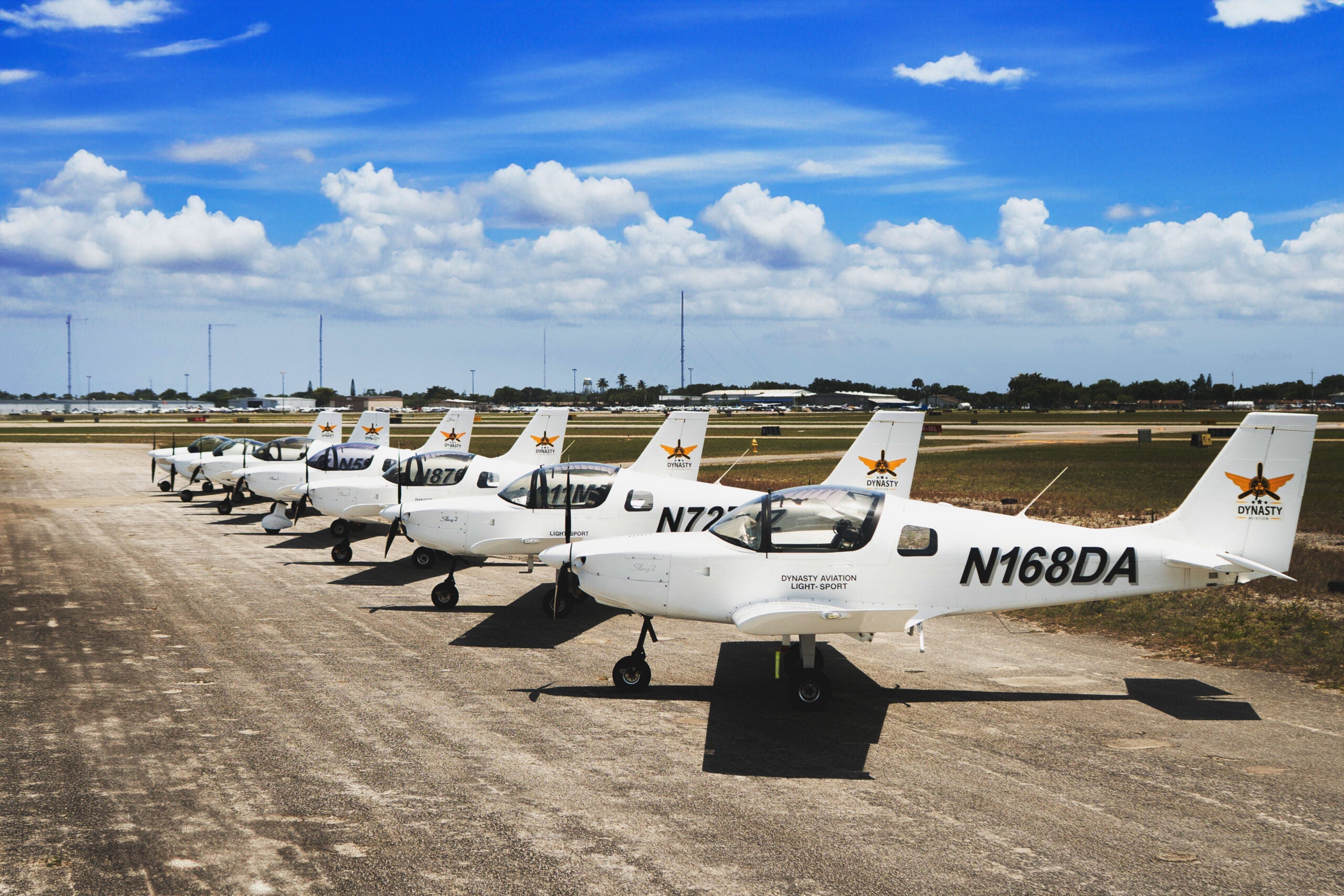
The preflight inspection is the first thing you do as pilot in command, every single time you fly. If something is wrong with the aircraft and you miss it on the ground, you find it in the air, and that is a different problem entirely. This guide walks through every station in the sequence Dynasty Aviation instructors teach from day one. Watch the video above for the visual reference, then use this as the written companion to build the mental model behind each step.
Before You Touch the Aircraft
The preflight starts before you step outside. Documents are confirmed and the cockpit is set to the correct state before the walkaround begins.
The FAA requires four documents on board for every flight. Students learn the AROW acronym to remember them.
- A Airworthiness Certificate, displayed in the cockpit
- R Registration Certificate, current and not expired
- O Operating Handbook (POH) for the Sling 2
- W Weight and Balance data, current for this aircraft
- Master switch OFF
- Avionics master OFF
- Magnetos / ignition OFF
- Fuel selector BOTH
- Flight controls free and correct through full range of motion, no binding
- Hobbs and tach time noted for the aircraft log
The Exterior Walkaround
Start at the cockpit door on the left side and work clockwise around the aircraft. Same direction, same sequence, every single preflight.
- Fuselage skin: no cracks, dents, or deformation
- Canopy latch and seal in good condition
- Antennas secure, no damage
- Static ports clear and unobstructed
- Pitot tube cover removed — confirm it is not on the aircraft
Work from the wing root outward to the tip. The Sling 2 is an aluminum structure. Leading edge dents, even small ones, can alter lift and stall behavior.
- Leading edge: no dents, deformation, or damage
- Wing skin: no cracks, no loose rivets
- Wing tip intact, no cracks
- Navigation light secure, lens undamaged
- Fuel cap secure and properly seated
- Fuel level visually confirmed — look in the tank, do not rely on the gauge alone
- Fuel color blue (100LL), confirming correct fuel type
- Sump drain sampled with tester cup: check for water (appears as a clear layer below the blue avgas)
- Fuel vent unobstructed
- Aileron: no cracks, dents, or damage
- Aileron hinges secure, no excessive play
- Aileron moves freely through full range of motion
- Aileron deflection correct: right stick = right aileron up, left aileron down
- Flap undamaged, hinges secure, position matches cockpit indicator
Take your time here. Engine condition, oil level, coolant level, and propeller integrity are all checked at this station.
- Propeller blades: no nicks, cracks, or damage — run your fingers along the leading edge of each blade
- Spinner secure, no cracks
- Engine oil level within operating range (check dipstick — Rotax 912ULS takes approx. 3 liters)
- Coolant level confirmed in reservoir — the 912ULS is liquid-cooled
- Cowling fasteners all secure
- Air inlets and filter unobstructed, no foreign material
- Exhaust: no cracks, mounting secure
- Engine compartment: no fluid leaks, no loose wiring
- Nosegear strut correct inflation, no damage
- Nosegear tire correct inflation, no flat spots, tread acceptable
- Steering linkage secure
Repeat the full left wing inspection on the right side. Do not let familiarity with one side cause you to rush the other. Things that damage aircraft often happen asymmetrically.
- Right aileron: no damage, hinges secure, full range of motion
- Right flap: undamaged, position matches cockpit
- Right wing leading edge: no dents or deformation
- Right wing skin: no cracks, no loose rivets
- Right wing tip intact, nav light secure
- Right fuel cap secure and properly seated
- Right fuel level visually confirmed
- Right fuel sump drained and sampled, clear of water
- Right fuel vent unobstructed
- Main gear tires: correct inflation, no flat spots, no visible cord or sidewall cracking
- Gear legs: no cracks or deformation
- Brake lines: no chafing, no fluid leaks
- Brake discs and calipers: no visible damage or excessive wear
- Horizontal stabilizer secure, no damage
- Elevator: no damage, moves freely, hinges secure
- Elevator deflection correct: stick back = elevator up
- Trim tab undamaged and secure
- Vertical stabilizer secure, no damage
- Rudder: no damage, moves freely through full range
- Rudder deflection correct: right rudder pedal = rudder deflects right
- Strobe and tail light secure
- Tail tie-down removed if installed
- Right fuselage skin: no damage
- Right door: latches functioning, seal intact
- All chocks removed
- All tie-downs removed and stowed
- Ramp area clear of equipment, tools, and personnel
- Pitot tube cover confirmed removed — check this again before stepping in
- Both fuel caps confirmed secure
Final Cockpit Check Before Engine Start
Strap in, run this final sequence, then proceed to the engine start checklist.
- Seat locked in position, no fore-aft movement
- Harness fastened and snug
- All circuit breakers IN
- Brakes set
- Fuel selector BOTH
- Throttle closed / idle
- Master ON: instrument panel scan, no flags or warning lights
- Passenger briefing completed: seatbelt, exits, sterile cockpit, no touching controls
- Doors closed and latched
- Briefing sheet completed
Preflight Station Summary
A memory aid during training. Not a substitute for the POH checklist.
| # | Station | Key Items | Stop-Flight Condition |
|---|---|---|---|
| 1 | Documents (AROW) | Airworthiness, registration, POH, W&B | Any document missing or expired |
| 2 | Cockpit initial | Master off, controls free, fuel selector | Controls binding or restricted |
| 3 | Left fuselage | Skin, canopy, static ports, pitot | Blocked pitot or static port |
| 4 | Left wing | Leading edge, skin, nav light, tip | Structural damage, loose rivets |
| 5 | Left fuel | Cap, level, sump sample, vent | Water in fuel, wrong fuel type |
| 6 | Left aileron / flap | Surface, hinges, range, deflection | Damage, restricted movement |
| 7 | Nose / engine | Prop, oil, coolant, cowling, nosegear | Prop damage, low oil, low coolant, fluid leaks |
| 8 | Right wing | Mirror of left wing | Mirror of left wing |
| 9 | Main gear | Tires, struts, brake lines | Flat tire, brake fluid leak |
| 10 | Empennage | Elevator, rudder, trim, tie-downs | Structural damage, tie-down still on |
| 11 | Right fuselage | Skin, door, chocks, area clear | Chocks or tie-downs not removed |
| 12 | Final cockpit | Harness, breakers, instruments, doors | Warning flags, breakers pulled |
What the Preflight Is Actually Teaching You
Student pilots often treat the preflight as something to get through before the flying starts. That framing is backwards.
The preflight is where you start thinking like pilot in command. Before the engine starts, before ATC gives you a frequency, before you touch the throttle: you are the one who decides whether this aircraft is airworthy and whether this flight happens. That is not a formality. That is the job.
The Sling 2 does not hide problems. A thorough preflight will surface issues before they matter. The pilots who rush the sequence, skip stations, or assume the previous pilot caught anything wrong are the ones who occasionally find something in the air that they should have found on the ground.
Run this sequence the same way every time. Same starting point, same direction, every item confirmed before moving to the next. When the sequence is automatic, you will notice anomalies without consciously searching for them. That instinct takes repetition to build, and it starts here, at North Perry Airport, before your very first flight lesson.
Sling 2 Preflight FAQ
How long does a Sling 2 preflight take?
About 15 to 20 minutes once you know the aircraft well. Early in training, budget 25 to 30 minutes. The goal over time is not to do it faster. It is to do it completely, in a consistent sequence, without losing any steps. Speed comes from familiarity, not from cutting corners.
Can I skip the preflight if the aircraft just flew?
No. Every flight requires a full preflight regardless of how recently the aircraft flew or who flew it before you. Fuel levels drop between flights. Oil migrates. Discrepancies the previous pilot did not notice or did not report may exist. The previous pilot's preflight covered their flight. Yours covers yours.
What fuel does the Sling 2 use and how do I check for water?
The Sling 2 at Dynasty Aviation uses 100LL avgas, which is dyed blue. Drain a small sample from each sump drain point into a clear tester cup and hold it up to the light. Water is denser than avgas and settles to the bottom, appearing as a clear layer beneath the blue fuel. If you see it, drain again until the sample runs clean. If water keeps appearing, the aircraft does not fly until the issue is addressed.
What do I do if I find something wrong during the preflight?
Do not fly the aircraft until the discrepancy is resolved. If you are a student, notify your CFI immediately and describe what you found. Your instructor will determine whether it is a go/no-go item or needs a maintenance writeup before the aircraft flies again. Document what you found in the aircraft log. There is no such thing as a discrepancy that is probably fine. Either the aircraft is airworthy or it is not.
What is the difference between a preflight inspection and a walkaround?
The terms are often used interchangeably. Technically, a walkaround refers to the exterior circuit around the aircraft. The full preflight inspection includes cockpit preparation, document verification, fuel and oil checks, and then the exterior walkaround. At Dynasty Aviation, students are trained to treat the entire sequence as the preflight, not just the outside portion.
Come See the Sling 2 in Person
A Discovery Flight at North Perry Airport starts with a real preflight briefing before you ever leave the ground. Fly the Sling 2 over Fort Lauderdale and Miami with a Dynasty CFI and see what training here actually looks like.
Book a Discovery Flight Schedule a Tour
Share:
What Happens at an FAA Checkride? Complete 2026 Guide
How to Build Flight Hours Fast: The CFI Path Explained (2026)