

After earning your Commercial Pilot certificate, you are qualified to be paid to fly but you are not yet qualified for the airlines. The FAA requires 1,500 total flight hours for an Airline Transport Pilot certificate, which is the minimum to sit in a commercial airline cockpit as first officer.
Most pilots finish their Commercial training with 190 to 250 total hours. That leaves a gap of roughly 1,250 to 1,300 hours between your Commercial certificate and airline eligibility. How you close that gap determines how fast you get to the airlines, how much it costs, and how prepared you are when you get there.
There is one path that stands above every other option. It gets you to 1,500 hours faster than any alternative, it pays you while you do it, it develops your aeronautical judgment at a level self-funded flying cannot replicate, and it produces a logbook that airline recruiters value. That path is becoming a Certified Flight Instructor.
The 1,500-Hour Problem
The math on closing the gap without instructing is brutal. If you pay standard South Florida wet rates to fly a single-engine trainer and build 1,250 hours independently, you are looking at $150 to $220 per hour multiplied by 1,250 hours. That is $187,500 to $275,000 in additional out-of-pocket flying costs after you have already spent $40,000 to $80,000 on training.
No one does this. The pilots who reach the airlines efficiently do it by getting paid to fly rather than paying to fly. CFI is how that happens.
Why CFI Is the Standard Path to the Airlines
Certified Flight Instructors get paid to log flight time. Every lesson you teach in a training aircraft, every cross-country you fly as an instructor supervising a student, every hour logged in the left seat while your student practices builds toward your 1,500-hour total.
Active flight instructors at busy flight schools log 60 to 80 flight hours per month. At that pace:
- 60 hours per month: 1,500 total hours reached in approximately 21 months from your first lesson
- 70 hours per month: 1,500 total hours reached in approximately 18 months from your first lesson
- 80 hours per month: 1,500 total hours reached in approximately 16 months from your first lesson
That timeline assumes you begin instructing with roughly 200 to 250 total hours from your Commercial training. The remaining 1,250 to 1,300 hours are built instructing, at a rate that depends on how many students you are teaching and how consistently you fly.
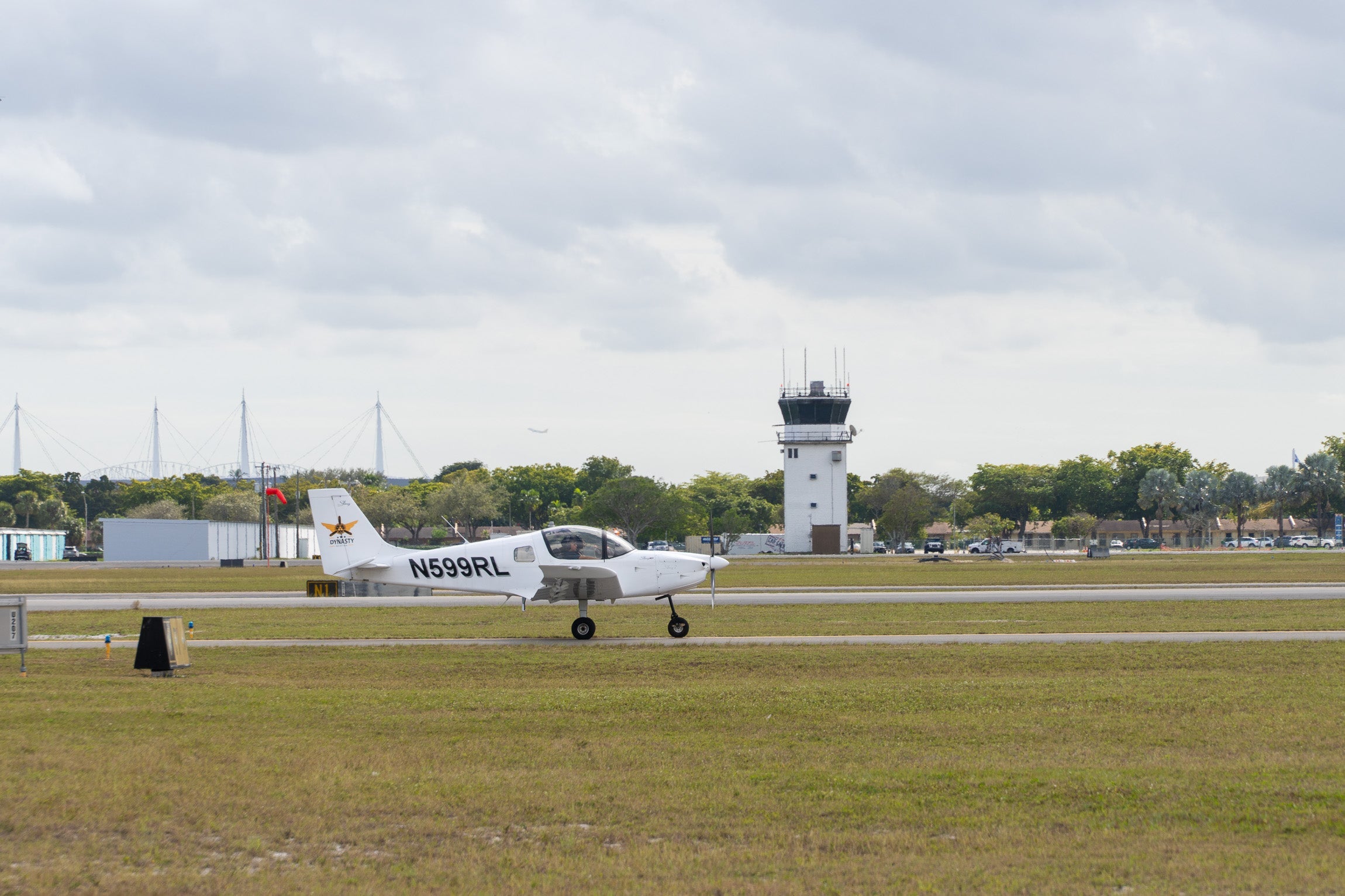
In South Florida, the year-round flying weather means instructors fly continuously without the winter slowdowns and weather cancellations that reduce monthly hour totals at schools in seasonal climates. A CFI at Dynasty Aviation's North Perry Airport base has the potential to build hours at a pace that instructors at northern schools cannot match.
What the CFI Path Actually Looks Like Step by Step
Step 1: Earn Your Commercial Pilot Certificate
CFI eligibility requires a Commercial Pilot certificate. Most career-track students complete their Commercial training through Dynasty Aviation's Part 141 Commercial program with a minimum of 190 total hours. That certificate authorizes you to fly for compensation and is the prerequisite for every instructor rating that follows.
Step 2: Earn Your CFI Certificate
The Certified Flight Instructor certificate authorizes you to teach student pilots in single-engine aircraft. CFI training at Dynasty Aviation starts at $5,700 and takes approximately one month for prepared commercial pilots.
CFI training covers how to teach aeronautical concepts, how to demonstrate maneuvers from the right seat, how to evaluate student performance against FAA Airman Certification Standards, and how to conduct endorsements, stage checks, and solo authorizations. You already know how to fly. CFI training teaches you how to teach flying, which is a different skill set and one you will use every day as an instructor.
Step 3: Earn Your CFII and MEI
The Certified Flight Instructor Instrument (CFII) rating authorizes you to teach instrument training. The Multi-Engine Instructor (MEI) rating authorizes you to teach in multi-engine aircraft. Both expand your student base significantly and increase your monthly hour-building rate because you can now teach more students across more programs.
A CFI who can only teach single-engine VFR students is limited to one category of student. A CFI who holds CFII and MEI ratings can teach primary students, instrument students, multi-engine students, and commercial candidates. More students means more flight hours per month.
At Dynasty Aviation, CFII and MEI training typically takes one to two months each for prepared candidates. Most career-track pilots complete all three ratings, CFI, CFII, and MEI, within three to five months of finishing their Commercial certificate.
Step 4: Get Hired as an Instructor
This is where school selection during your initial training pays a direct dividend. Flight schools that train their own students and then hire them as instructors provide a seamless transition from training to instructing. Schools without that pipeline leave newly certificated CFIs to find their own instruction opportunities, which introduces delays and uncertainty into the hour-building phase.
Dynasty Aviation's Elite Cadet Program includes a guaranteed instructor position at North Perry Airport for graduates who complete the program. Students who enter the Elite Cadet pathway with a Private Pilot License and Instrument Rating progress through the Commercial certificate and all three instructor ratings in eight months, then transition directly into a paid instructing role with a guaranteed pathway to 1,500 flight hours. The transition from student to employed instructor is built into the program rather than left to chance.
Step 5: Build Hours Systematically
Once hired, the goal is simple: fly as much as possible, log every hour, and diversify the type of flying you log. A strong logbook for airline recruiters includes:
- High total hours in the primary aircraft category
- Significant cross-country time, including cross-countries of substantial length
- Night hours above the minimum requirements
- Instrument time, both actual and simulated
- Multi-engine time as a component of total hours
- Hours logged as pilot-in-command across a range of operations
Instructing covers most of these categories naturally. Every student cross-country you supervise builds your cross-country PIC time. Every instrument lesson you teach builds your instrument time. Every night lesson builds night hours. The diversity of instruction work produces exactly the logbook profile that airline interviewers look for.
How Much Do CFIs Earn in South Florida?
Flight instructor compensation in South Florida in 2026 runs approximately $25 to $45 per flight hour for new instructors at established schools, with additional income from ground instruction and stage check fees. At 60 to 80 flight hours per month, that translates to:
- Low end (60 hours at $25/hr): approximately $1,500 per month in flight pay
- Mid range (70 hours at $35/hr): approximately $2,450 per month in flight pay
- High end (80 hours at $45/hr): approximately $3,600 per month in flight pay
Ground instruction and administrative compensation adds to these figures at many schools. The financial picture of CFI instructing is not getting rich. It is building hours toward a career where first-year regional first officers currently earn $80,000 to $110,000 annually, and the trade-off is clear.
Some instructors supplement their income with additional flying work during their time-building phase, which brings up the other methods worth understanding.
Other Hour-Building Methods: Honest Assessment
The CFI path is the standard because it works best for most pilots. But it is worth understanding the alternatives and their tradeoffs.
Banner towing: Pays for the flying, builds hours, typically seasonal with peak work in summer months. Requires an additional endorsement and is physically demanding. Works as a supplement to instructing in South Florida's tourism corridor but not as a replacement for it.
Pipeline and powerline patrol: Requires specific aircraft and geographic access. Low-level flying that builds precision skills. Irregular availability and limited positions make it difficult to plan around.
Ferry flying: Moves aircraft between locations. Irregular, requires strong navigation skills, and positions are not always available to low-hour pilots. Useful supplement when opportunities arise, not a primary strategy.
Paying for additional flight time: As covered above, the math does not work for most pilots. At $150 to $220 per hour, flying 1,250 hours independently is financially prohibitive for the vast majority of commercial pilots.
Part 135 charter: Requires 500 hours for most operations and 1,000 to 1,200 hours for many single-pilot IFR charter positions. Not an option immediately post-Commercial but worth targeting once you reach the minimum thresholds while instructing.
The practical strategy for most career-track pilots is CFI as the primary hour-building vehicle, supplemented by any additional flying opportunities that arise without conflicting with your instruction schedule.
The R-ATP Option: Can You Get to the Airlines with Fewer Hours?
Yes, under specific circumstances. The Restricted Airline Transport Pilot (R-ATP) certificate allows pilots to qualify for first officer positions with fewer than 1,500 hours through one of two pathways:
Military pilots: Eligible for ATP with 750 total hours. Aviation degree holders: Pilots who hold a four-year aviation degree from an FAA-approved institution may qualify for R-ATP with 1,000 hours. A two-year aviation degree qualifies at 1,250 hours.
For career-track pilots coming through a civilian training pathway without a qualifying aviation degree, the standard 1,500-hour requirement applies. Most regional airlines hire directly at 1,500 hours without requiring the R-ATP route, and the distinction matters less in practical terms than it once did given the current hiring environment.
If you hold or are pursuing an aviation degree, verify whether your institution's program qualifies for R-ATP eligibility. It could reduce your time-building requirement by 250 to 500 hours, which at 70 hours per month represents three to seven months of instructing time saved.
Why Dynasty Aviation Is the Right Place to Build Hours
The factors that determine how fast a CFI builds hours are student volume, aircraft availability, scheduling consistency, and school stability. A CFI at a school with insufficient students, frequent aircraft groundings, or unpredictable scheduling builds hours slowly regardless of how good an instructor they are.
Dynasty Aviation at North Perry Airport (KHWO) offers:
Consistent student demand: North Perry is one of the most active general aviation training environments in the country. Demand for structured Part 141 instruction in modern glass-cockpit aircraft keeps Dynasty Aviation's instructor roster consistently active.
Modern fleet with in-house maintenance: Aircraft availability is the most direct lever on monthly hour totals. In-house maintenance at Dynasty Aviation minimizes unscheduled groundings that cost instructors flying days.
Year-round South Florida weather: More than 300 flyable days per year means instructors at KHWO fly more months per year than instructors at schools in seasonal climates, which compounds over the 12 to 18 months of the time-building phase.
Direct airline partnerships: Dynasty Aviation's cadet program partnerships with PSA Airlines and Piedmont Airlines give instructors building hours at KHWO a pipeline to regional airline hiring that begins during the time-building phase rather than after it.
Career progression built into the program: The Elite Cadet Program is structured specifically to move students through training and into the instructor role efficiently, then support them through the time-building phase with a guaranteed position and airline pipeline access. It is not a training program that ends at the Commercial certificate and leaves students to figure out the rest.
The Timeline: Zero to Airline in South Florida
For students who begin training with no prior flight experience and commit to the career pathway at Dynasty Aviation:
| Phase | Duration | Hours Logged |
|---|---|---|
| Private Pilot License | 2 to 3 months | ~55 to 65 hours |
| Instrument Rating | 2 to 3 months | ~90 to 110 hours |
| Commercial Pilot License | 3 to 5 months | ~190 to 250 hours |
| CFI / CFII / MEI | 3 to 5 months | ~230 to 290 hours |
| Time building as CFI | 12 to 18 months | 1,500 hours |
| Total to airline eligibility | 22 to 34 months | 1,500 hours |
Full-time students at the faster end of those ranges can reach airline eligibility in under two years. Part-time students with career goals should plan for three to four years total.
Ready to Start the Path?
The CFI pathway is not complicated. It is a sequence of certificates and ratings that leads directly to an airline cockpit, provided you execute each stage efficiently and in the right environment. Dynasty Aviation's Elite Cadet Program is built around exactly that sequence, with the instructor position and airline pipeline built in from the start.
The first step is a discovery flight or a conversation with the admissions team about which entry point into the program makes sense for your current certificate level and timeline.
For a full breakdown of what the path costs, see the Florida flight school cost guide. For the complete airline pilot roadmap, see the how to become an airline pilot guide.
Book a Discovery Flight | View CFI Training | View the Elite Cadet Program | See All Programs
Dynasty Aviation is an FAA Part 141 approved flight school based at North Perry Airport (KHWO) in Pembroke Pines, Florida, serving student pilots throughout Fort Lauderdale, Miami, Broward County, and South Florida.
分享:
How to Preflight the Sling 2: Step-by-Step Guide
Flight School Miramar FL